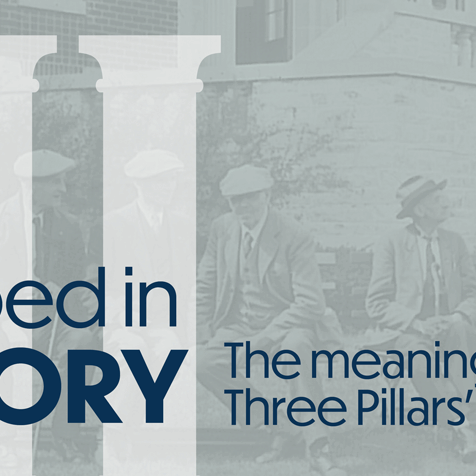
The Story of Our Legacy Buildings – The Historic Carriage House, Chapel, and Farm Buildings
If you’ve ever visited or driven by Three Pillars Senior Living Communities in Dousman – nestled in the beautiful Lake Country area – you’ve likely been captivated by a trio of beautiful, petite, creamy brick buildings.
Nestled on the north side of Highway 18 / Sunset Drive, these buildings, now lovingly called our “Legacy Buildings,” have been standing tall since the mid 1800s. We’ve proudly cared for them over the years so that countless more people can appreciate them for decades more.
Want to know more about their story and their significance on our current campus?
The Beginnings | Elisha Edgerton
The Legacy Buildings exist thanks to Mr. Elisha Edgerton. What’s his story?
In the 1830’s, four brothers named Edgerton set out westward from Connecticut to settle and make their fortunes. One brother settled in Illinois, and the other three made it to Wisconsin. By 1835, they had settled in Milwaukee. Elisha Edgerton secured a job with Solomon Juneau as a general handyman, and in 1836, opened one of the first lumberyards for Juneau.
Between 1836 and 1837, Elisha was invited to take part in an expedition, along with Mr. Talbot Dousman, to further explore the Rock River and potentially scout for additional Juneau mill sites.
Traveling by oxen-drawn wagon, Elisha arrived at the land that is now Three Pillars in Dousman, (then called “Summit Township”), and staked a claim. With over 800 acres and a robust spring, he knew this was the place to live out his future.
In 1838, Elisha married Belinda, another Connecticut native, who arrived at the property soon after. Together, they cleared the land and developed a farm, building a home and buildings in neo-Gothic style.
The farm would soon flourish with animals and thriving wheat crops, earning statewide acclaim and recognition by the Wisconsin State Agricultural Society as an award-winning Premium farm and “Best Farm in the State.”
In 1843, when the government required it, the Edgertons purchased the land for $1.25 per acre and became the first official landowners of the property on March 3, 1843.
The Legacy Buildings’ Construction
In 1854, as they continued to enhance their farm, the Edgertons built the Gothic Revival Carriage House, Dairy, Smokehouse/Outhouse, and Granary buildings, which were important new structures on their farm.
As devout Episcopalians, the Edgertons attended worship services at the Utica Post Office, which was one of the first community buildings in their town. The gathering there was called “Southside Mission,” and it’s reported that people often walked up to eight miles to attend.

In 1859, Belinda urged Elisha to build a chapel atop their Carriage House building (the largest of the three), to create a new, more spacious and dedicated space for worship. It was completed, and Episcopal services were moved to this chapel on the upper level, where early settlers and those in the surrounding area were invited to worship.
Early Ties to St. Mary’s Episcopal Church in Dousman
This second-floor Edgerton chapel is tied to the early beginnings of the building’s current next-door-neighbor, St. Mary’s Episcopal Church in Dousman. Around the mid-1860s, Belinda named their second-floor chapel “Santa Maria,” which later became anglicized to “St. Mary’s.”
According to an essay by the late Carol McConnell, St. Mary’s longtime parishioner and history expert, some of their church’s earliest history archives feature notes about the Edgerton farm Chapel.
One letter from a late 1800’s convention states: “The services at Utica Post Office have been removed to the Chapel, generously provided by E.W. Edgerton, Esq. and known as Southside.”
Reverend William H. Stoy noted: “I have to report that I have officiated regularly during the year on alternate Sundays in the missionary chapel at Mr. Edgerton’s farm. Attendance upon Divine Service at this place has been unusually very good, and the Sunday school under the charge of two of the students from Nashotah, has lost nothing of its fullness and vigor. No move has been made as yet to organize a parish at this point, though we have numbers sufficient in communicants and in regularly attendant families to warrant it. We trust ere long to be able to report of such organization, since it would be the cause of much more concentration of effort and much greater vitality in the congregation.”
The Carriage House chapel eventually led the way to the construction of St. Mary’s Church. Their chapel was finished on August 30, 1871, built in a similar Gothic style to complement the neighboring Carriage House. The first service was held on March 30, Easter Sunday, 1872. The Edgertons continued farming and using the buildings until around this time, when they sold and moved.
The Legacy Buildings’ Significance Today

From 1854 to today, for the original owners and with each one since, these three Legacy Buildings have stood tall and proud. They’ve seen ups and downs, fires and storms, and countless people and stories. They’ve housed grains, stored dairy products, protected farm tools, and smoked meats. They’ve hosted worship services, provided critical functionality for farmers, and been a constant in each land owner’s life.
Today, they represent our pride in the deep-rooted history of Three Pillars and, perhaps even more significantly, our respect for the land and the people who came before us.
We’ve cared for and maintained the Legacy Buildings throughout the years, and they’re poised to stand for decades to come. The newest part of our campus, The Fields At Three Pillars, was thoughtfully planned around the Legacy Buildings to ensure they’re the main focal point and central landmark at the main entrance of the community.
The next time you drive by or come to visit us, give them a nod and smile at your newfound knowledge about their story.
Want to Learn More?
We love sharing about our campus – whether it’s living options, services, programs, or more about our history. Contact us any time and come out for a visit!